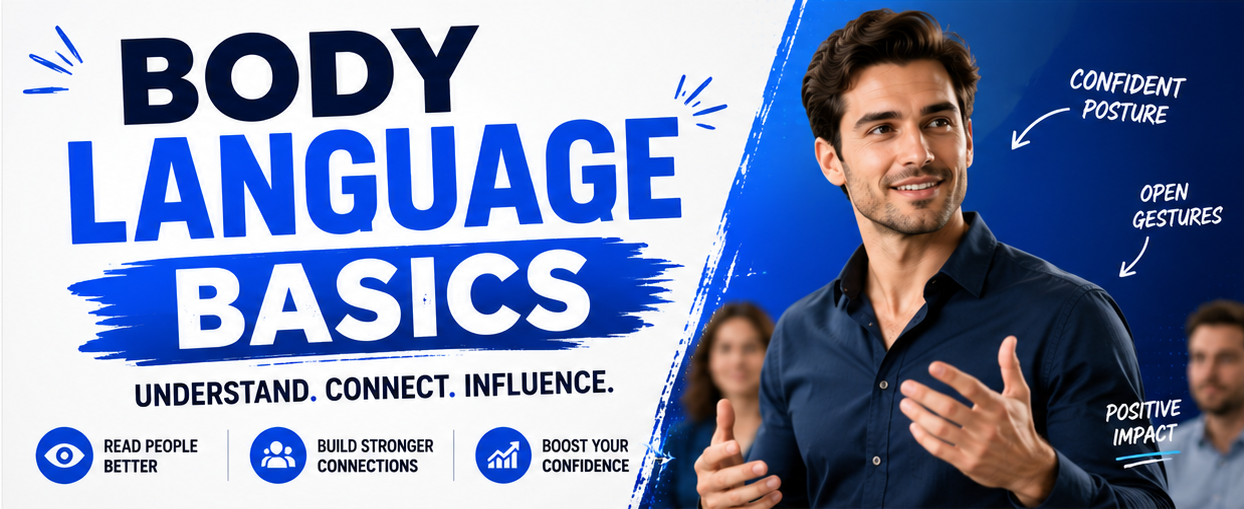
About this course
This course introduces students to the fundamental concepts and practices of Body Language Basics, essential for understanding non-verbal communication in personal and professional interactions. It covers facial expressions, gestures, posture, eye contact, personal space, and micro-expressions.
Through demonstrations, case studies, and interactive exercises, learners will analyze how body language influences communication, trust, confidence, and interpretation of messages. The course also explores cultural differences in non-verbal communication and practical techniques for improving awareness and control of body language, preparing students to communicate more effectively in real-world situations.
Learning Objectives
By the end of this course, students will be able to:
- Explain the fundamental principles of non-verbal communication and body language.
- Differentiate between positive and negative body language signals.
- Evaluate the impact of gestures, posture, and facial expressions in communication.
- Analyze how body language varies across cultures and contexts.
- Identify techniques for improving personal non-verbal communication skills.
- Develop strategies for interpreting and using body language effectively.
Target Audience
- Students and early-career professionals.
- Managers and team leaders.
- HR and communication professionals.
- Sales, customer service, and client-facing roles.
- Anyone interested in improving interpersonal communication skills.
Course Format
- Lectures & Discussions: Key concepts of non-verbal communication.
- Video Analysis: Studying real-world body language examples.
- Practical Exercises: Role-playing and gesture interpretation activities.
- Assessments: Quizzes, observation tasks, and a final communication improvement project.
Expected Outcomes
Upon completion of this course, students will be able to:
- Demonstrate a working knowledge of body language principles.
- Assess non-verbal cues in communication effectively.
- Recommend suitable improvements for personal communication style.
- Develop informed approaches for interpreting others' behavior.
- Bridge the gap between verbal messages and non-verbal signals in communication.